SPORTPLAN
DiscoverTop RacesBlog
Sign in
SPORTPLAN

A clearer way to discover events, build your season, and keep results in one place.

DiscoverAboutContactPrivacy Policy
hello@dockia.es

© 2026 SportPlan. All rights reserved.

by Dockia

SPORTPLAN

A clearer way to discover events, build your season, and keep results in one place.

hello@dockia.es

Product

  • Discover
  • Top Races
  • Blog
  • Blog

Sports

  • Running
  • Trail Running
  • Triathlon
  • Gravel
  • Road Cycling
  • HYROX
  • OCR / Spartan
  • Swimming

Cities

  • Barcelona
  • Madrid
  • Valencia
  • Sevilla
  • Bilbao
  • Málaga
  • Girona
  • Zaragoza

Company

  • About
  • Contact
  • Privacy Policy
  • Terms of Service
  • Cookie Policy

© 2026 SportPlan. All rights reserved.

by Dockia

DiscoverTop RacesSign in
Zegama-Aizkorri 2026: The Complete Guide to the World's Greatest Mountain Marathon | SportPlan
HomeBlogZegama-Aizkorri 2026: The Complete Guide to the World's Greatest Mountain Marathon
Zegama-Aizkorri 2026: The Complete Guide to the World's Greatest Mountain Marathon
Apr 3, 2026·7 min read·marathonguide

Zegama-Aizkorri 2026: The Complete Guide to the World's Greatest Mountain Marathon

Everything you need to know about Zegama-Aizkorri 2026: course breakdown km by km, entry, elite splits, aid stations, gear, logistics and race strategy.

There are races, and then there's Zegama-Aizkorri.

A village of 1,500 people. A mountain marathon that draws the best trail runners on earth. An atmosphere at the Sancti Spiritu checkpoint that has reduced grown athletes to tears. Every May, Zegama becomes the emotional center of the trail running world — not because of its prize money or production, but because of something harder to quantify: soul.

If you're already thinking about running it, this guide will tell you everything the official website won't.

On this page

What Is Zegama-Aizkorri?Entry and Registration for 2026The Course: Kilometer by KilometerSplit TimesAid StationsMandatory GearWeather in MayTraining Timeline

Related articles


What Is Zegama-Aizkorri?#

The Zegama-Aizkorri Mountain Marathon runs through the Aizkorri-Aratz Natural Park in Gipuzkoa, Basque Country. At 42.195 km with 2,736 meters of elevation gain, it's marathon distance — but nothing like a road marathon.

The race has been a fixture on the world trail calendar since the early 2000s and is now part of the Golden Trail World Series (GTWS) — the elite global trail racing circuit. Winning Zegama earns you a txapela (a traditional Basque beret), which in trail running circles carries more prestige than most trophies.

Kilian Jornet has won here more times than most runners have finished. Elhousine Elazzaoui, Manuel Merillas, Sara Alonso, Sylvia Nordskar — the best of the best come to Zegama.

2026 Race Facts:

  • 📅 Date: May 17, 2026
  • 📍 Location: Zegama, Gipuzkoa, Basque Country, Spain
  • 📏 Distance: 42.195 km
  • ⬆️ Elevation gain: 2,736 m
  • 🏆 Series: Golden Trail World Series (GTWS)
  • 👥 Marathon entries: ~545
  • 🌐 Official website: zegamaaizkorri.eus

📅 Add to your SportPlan calendar — free, 30 seconds.


Entry and Registration for 2026#

Zegama-Aizkorri has severely limited entries: approximately 545 places in the marathon. Access is by ballot (lottery) through the official website zegamaaizkorri.eus.

When does the ballot open? Typically between November and February before the race. Follow official channels so you don't miss the window.

Elite field: Elite runners are invited through the GTWS system. If you accumulate enough GTWS points, you may qualify for elite entry. Check goldentrailseries.com for the 2026 requirements.

Entry fee: Approximately €35-50 for the popular marathon (verify on the official website for 2026 pricing).

Vertical Kilometer: Also held around the same weekend (~248 entries), with its own txapela and elite field.

ℹ️ Last verified: March 29, 2026. Check zegamaaizkorri.eus for definitive 2026 details.


The Course: Kilometer by Kilometer#

This is not a course you can summarize as "hilly." Zegama is a series of blows — steep climbs, exposed ridgelines, and technical descents that destroy unprepared quads.

Start — Km 0-7: Zegama to Otzaurte#

The race starts in the village. The first kilometers wind through beech forests — deceptively runnable compared to what's coming. The crowd and atmosphere make everyone go out too fast. Classic mistake #1. Control your pace here. The real race starts later.

Otzaurte (km 7) — first aid station. Good moment to check in with yourself.

Km 7-13: Otzaurte to Ultzama-Atabarreta#

The terrain becomes more technical. The path climbs toward the Aizkorri ridgeline through rocky outcrops. Fog is common here — disorienting when dense, and cold arrives fast.

Ultzama-Atabarreta (km 13) — second aid station.

Km 13-20: The Heart of the Race#

The climb to Aratz (km 16) is demanding, but the pivotal moment is the Sancti Spiritu pass (km 20).

Sancti Spiritu is a hermitage above 900m altitude. The approach involves a brutal descent followed by a grueling climb. Dozens of spectators line the route here, screaming, cowbelling, handing out drinks. It's where well-prepared runners keep moving and the ones who went out too hard start to unravel.

Km 20-25: Aizkorri Ridgeline — Where Races Break#

After Sancti Spiritu, the route climbs to the high ridge. Aketegi (1,551 m) and Aitxuri (the highest peak in Euskadi) mark this section.

The technical descent between km 23-25 is where most DNFs happen. Wet rocks, steep gradient, no room for error. Rain is common in May in the Basque Country — and wet Aizkorri rock is genuinely treacherous.

Veteran advice: conserve your legs on the Sancti Spiritu descent so you have something left for the Aitxuri ridge. Attack the descent too hard and you'll pay on the way up.

Km 25-38: Urbia and the Valley#

After the ridge, the course drops to the Urbia plateau and Oltze refuge. A longer, more moderate section that can either restore your race or deceive you into thinking it's over.

Km 38-42.195: Final Climb to Andraitz and the Finish#

The course doesn't end gently. The final climb to Andraitz arrives when your legs are done. The descent back into the village goes through a crowd that hasn't stopped cheering all day. Cross the line and you'll understand why people come back year after year.


Split Times#

LevelEstimated finish time
Elite men (podium)3h00 – 3h20
Elite women (podium)3h30 – 4h00
Strong amateur runner4h00 – 5h00
Average mountain runner5h00 – 6h30

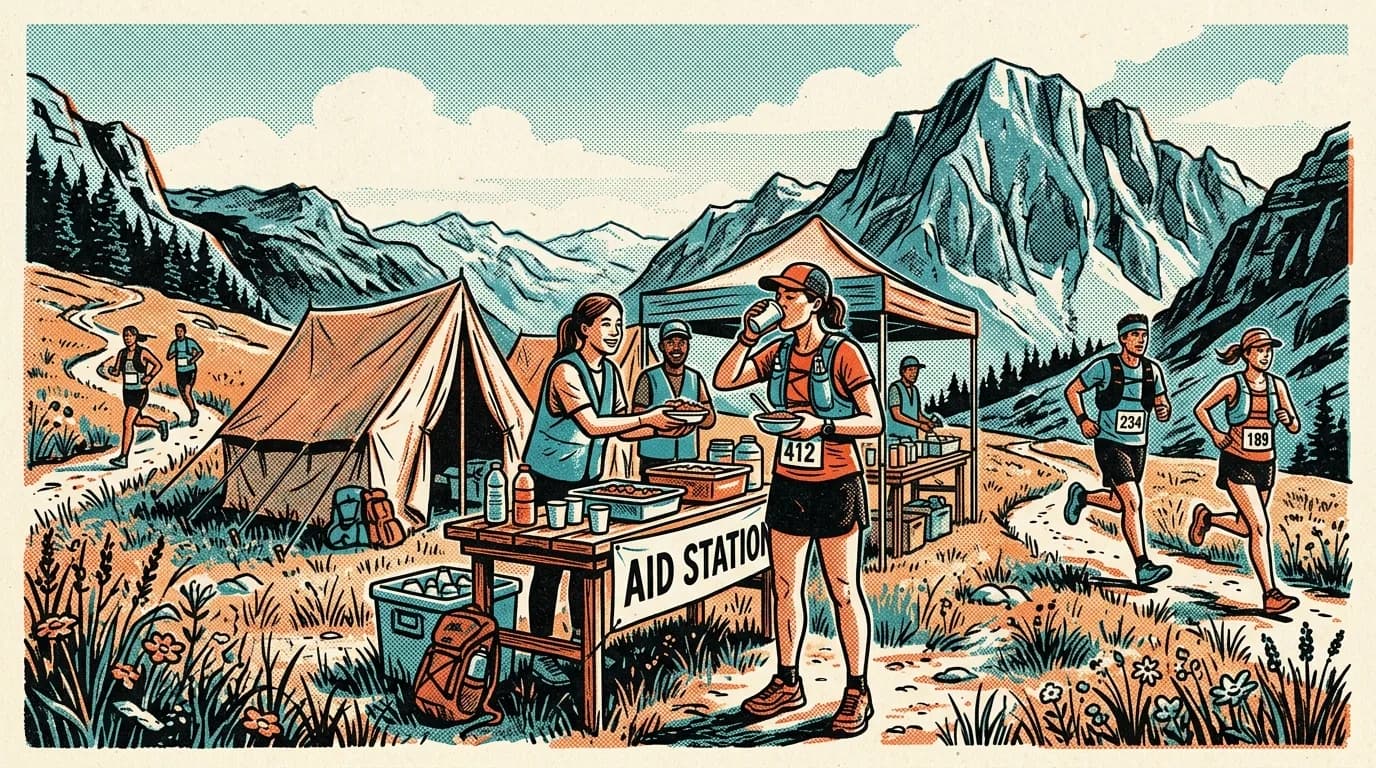
Aid Stations#

Station~kmTypically available
Otzaurte~7Water, fruit, cola
Ultzama-Atabarreta~13Water, fruit, gels
Sancti Spiritu~20Water, fruit, cola, broth
Urbia/Oltze~28Water, fruit, solids

Carry your own reserves for 1-2 hours in your pack. No aid station on the high ridge when it matters most.


Mandatory Gear#

Standard requirement for Zegama (verify the official list for 2026):

  • Waterproof jacket with sealed hood
  • Emergency (survival) blanket
  • Whistle
  • Headlamp with spare batteries
  • Emergency food supply
  • Minimum 500ml hydration capacity
  • Charged mobile phone

In May, you can have 15°C in the valley and 3°C with wind on the ridgeline — on the same day. Don't gamble on the gear.


Weather in May#

The Basque Country in May is unpredictable:

  • Valley temperature: 10–18°C
  • Ridgeline temperature: 3–10°C with wind
  • Rain: High probability. Aizkorri is a high-precipitation zone.
  • Fog: Common on crests, especially morning

Train in rain and wind before the race. If your body only performs in perfect conditions, Zegama will teach you a lesson.


Training Timeline#

5-6 months out (December–January)#

  • Build aerobic base: 50-80 km/week, 4-5 sessions
  • Strength work: squats, lunges, eccentric quad loading
  • Begin descents training — this is where Zegama is won or lost

3-4 months out (February–March)#

  • Increase weekly elevation: target 2,000–3,000 m D+ per week
  • Long runs of 3-5 hours with real mountain gain
  • First tune-up race (30-50 km)

1-2 months out (April–May)#

  • Peak weeks: 70-90 km with 4,000-5,000 m D+
  • Simulate the course: find long ridge sections and technical descents
  • 2-3 weeks out: begin tapering
  • 10 days out: volume drops, quality over quantity

The differentiator: most runners train uphills and neglect downhills. At Zegama, your descending ability determines if you finish.


Getting There#

By Air#

  • Nearest airport: San Sebastián-Hondarribia (EAS, ~35 km). Limited connections.
  • Main airport: Bilbao (BIO, ~65 km). Excellent European connections.

By Train#

  • Stations: Zumarraga or Beasain (~8 km from Zegama). Euskotren from San Sebastián.

By Car#

  • Motorway: AP-1, exit Zegama. Race parking available.

Accommodation#

With 1,500 inhabitants, Zegama fills up months in advance.

  • In Zegama: rural houses and private accommodations. Book 4-5 months ahead.
  • Beasain (10 km): hotels and guesthouses.
  • Ordizia (15 km): more availability.
  • San Sebastián (35-40 km): large hotel offer, but adds race-morning stress.

Price range: €60-150/night depending on type and proximity.

Pro tip: if you secure your entry, book accommodation the same day. Every year runners hold valid entries with nowhere to sleep.


Common First-Timer Mistakes#

  1. Starting too fast. The atmosphere is electric. Restrain yourself for the first 7 km.
  2. Not training descents. The km 23-25 descent decides your race.
  3. Underestimating the ridge. Wind and cold drain energy you didn't budget for.
  4. Incomplete mandatory gear. You can be pulled at any checkpoint.
  5. Booking accommodation late. Zegama fills.
  6. No fog/wet terrain experience. If you've only trained on dry, smooth trails, the Aizkorri will be a shock.

Recent Results#

2025 elite highlights:

  • Men: Elhousine Elazzaoui (2024 runner-up, GTWS circuit leader), Manuel Merillas (2023 champion under mud conditions)
  • Women: Sylvia Nordskar (defending champion), Sara Alonso (local favorite, 2025 contender)

Course record (men): Kilian Jornet (multiple wins, fastest time on the historic course)

Kilian Jornet won Zegama so many times that his record here became part of his legend. The course record stands as the benchmark every elite runner measures themselves against.


ℹ️ Last verified: March 29, 2026. Course data based on the 2025 edition. The 2026 edition may include modifications. Always check zegamaaizkorri.eus for official and final information.

Found this useful? Share it with your training crew.
Full trail running calendar →

Keep planning

Use SportPlan to compare dates, save target events, and build a season that fits your weekends instead of another unstructured list.

Browse events
← Back to blog
marathonguide
Apr 3, 2026·6 min read

Zegama-Aizkorri 2026: The Complete Guide to the World's Hardest Mountain Marathon

Everything about Zegama-Aizkorri 2026: 42.2 km, 5,400m D+, May 17, 25th anniversary. Lottery entry, Golden Trail World Series, training and travel guide.

marathonguide
Mar 30, 2026·10 min read

Zegama-Aizkorri 2026 : Le Guide Complet du Marathon de Montagne le Plus Difficile au Monde

Tout sur Zegama-Aizkorri 2026 : 42,2 km, 5.400m D+, 17 mai, 25e anniversaire. Tirage au sort, Golden Trail World Series, entraînement et logistique.

marathonguide
Mar 30, 2026·10 min read

Zegama-Aizkorri 2026: O Guia Completo da Maratona de Montanha Mais Difícil do Mundo

Tudo sobre Zegama-Aizkorri 2026: 42,2 km, 5.400m D+, 17 de maio, 25.º aniversário. Sorteio, Golden Trail World Series, treino e logística.